Exploring the Collection of Business and Technology: Visual Tools for Modern Communication
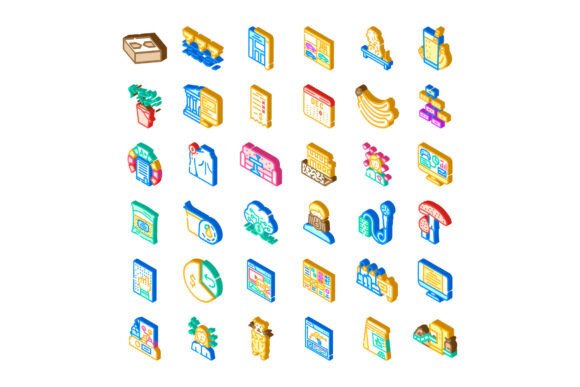
In today's fast-paced digital environment, visual communication plays a crucial role in conveying complex ideas efficiently. The Collection of Business and Technology offers a versatile set of isometric icons that simplify the representation of abstract concepts, workflows, and digital ecosystems. These illustrations are more than just aesthetic elements—they serve as intuitive tools for professionals, educators, and developers across a wide range of platforms.
Understanding Isometric Icons in Business and Technology Contexts
Isometric design, known for its three-dimensional appearance without perspective distortion, has become a popular choice in modern web and mobile interfaces. The Collection of Business and Technology leverages this style to present concepts in a visually engaging and easily digestible format. Whether illustrating cloud computing, team collaboration, or data analytics, these icons help users grasp ideas quickly without relying heavily on text.
Each icon is crafted with a balance of realism and abstraction, allowing for flexibility in application. For instance, a digital marketing team might use an icon representing online transactions to symbolize e-commerce growth, while an environmental researcher could use the same icon to discuss digital sustainability in financial systems.
Key Features of the Collection
- Scalability: Vector-based formats ensure icons remain sharp at any size, making them suitable for both mobile apps and large dashboard displays.
- Customizability: Color schemes and elements can be adjusted to match brand identities or interface themes without losing visual coherence.
- Consistency: Uniform angles, lighting, and proportions create a cohesive look across different topics and use cases.
- Extensive Coverage: The collection spans business operations, digital infrastructure, natural elements, and abstract metaphors, offering a comprehensive visual vocabulary.
Practical Applications Across Industries
The versatility of the Collection of Business and Technology makes it a valuable asset across multiple domains. Let's explore how different sectors and roles can benefit from these visual tools:
1. Web and Mobile Development
Designers and developers often use isometric icons to enhance user interfaces. These visuals can serve as navigation elements, feature highlights, or interactive components in dashboards. For example, a productivity app might use isometric icons to represent task categories such as scheduling, collaboration, and analytics.
Because these icons are modular and easy to integrate, they help streamline UI/UX workflows. Teams can maintain visual consistency across platforms while reducing the need for custom illustrations from scratch.
2. Education and Training Materials
Educators and instructional designers use isometric icons to simplify complex topics in digital literacy, business strategy, and environmental science. A course on digital marketing might use icons to illustrate SEO, social media, and content strategy. Similarly, a presentation on sustainable business practices could use nature-themed icons to represent renewable energy, green logistics, or eco-friendly supply chains.
These visuals aid in knowledge retention by transforming abstract ideas into recognizable symbols, making them especially useful in e-learning environments where visual engagement enhances comprehension.
3. Business Presentations and Reports
Professionals preparing reports, pitches, or internal communications often rely on isometric icons to enhance clarity and visual appeal. A financial analyst might use a server icon to represent cloud-based data storage or a team icon to illustrate collaborative workflows.
These graphics help break down complex systems into digestible visuals, allowing audiences to focus on key insights rather than getting lost in technical jargon. Moreover, the ability to customize colors and themes ensures that visuals align with company branding and messaging.
Why Isometric Icons Outperform Traditional Graphics
While flat icons and traditional illustrations have their place, isometric designs offer distinct advantages in modern digital communication:
- Depth and Realism: Unlike flat icons, isometric visuals provide a subtle 3D effect that adds realism without overwhelming the design.
- Engagement: Studies suggest that users respond more positively to visually rich content, and isometric icons strike a balance between simplicity and depth.
- Adaptability: These icons can be used in both minimalist and detailed interfaces, adapting to different design philosophies and user expectations.
- Timelessness: Isometric design trends have remained consistent over the years, making these icons a durable choice for long-term projects.
Businesses and creators who invest in the Collection of Business and Technology are not just acquiring a set of images—they are adopting a visual language that evolves with technological and design trends.
Considerations When Choosing and Implementing Icons
While isometric icons offer many benefits, selecting and using them effectively requires thoughtful planning. Here are some considerations to keep in mind:
1. Purpose and Context
Icons should serve a clear function within the design. Are they meant to guide users, explain a process, or highlight a feature? The Collection of Business and Technology includes icons tailored for specific functions, so selecting the right one depends on understanding the intended message and audience.
2. Consistency Across Platforms
For brands and applications with multiple touchpoints, maintaining visual consistency is key. Using a unified set of isometric icons helps reinforce brand identity and user familiarity. This is especially important in enterprise software, where users interact with various modules and interfaces.
3. Accessibility and Clarity
Even the most visually appealing icon is ineffective if it's unclear or inaccessible. Designers should ensure that icons are easily distinguishable, especially for users with visual impairments. Adding text labels or using high-contrast colors can enhance accessibility without compromising aesthetics.
Future Trends and Expanding Use Cases
As digital interfaces continue to evolve, the demand for intuitive and visually engaging content is expected to grow. The Collection of Business and Technology is well-positioned to meet this demand by expanding into new areas such as:
- Augmented Reality (AR) Interfaces: As AR applications become more mainstream, isometric icons may serve as intuitive navigation tools within immersive environments.
- AI-Driven Dashboards: With the rise of artificial intelligence in business analytics, icons can help users interpret complex data streams through simplified visual metaphors.
- Smart Device Ecosystems: From smart home interfaces to wearable tech, isometric icons provide a scalable and recognizable visual language across connected devices.
Looking ahead, the collection is likely to incorporate more interactive and animated elements, allowing developers to create dynamic user experiences without sacrificing clarity or performance.
Conclusion
The Collection of Business and Technology represents more than just a design toolkit—it's a bridge between complex ideas and intuitive understanding. By combining visual appeal with functional clarity, these isometric icons empower professionals, educators, and creators to communicate more effectively in an increasingly digital world. Whether used in a mobile app, educational module, or corporate presentation, they offer a powerful way to simplify complexity and enhance engagement.